


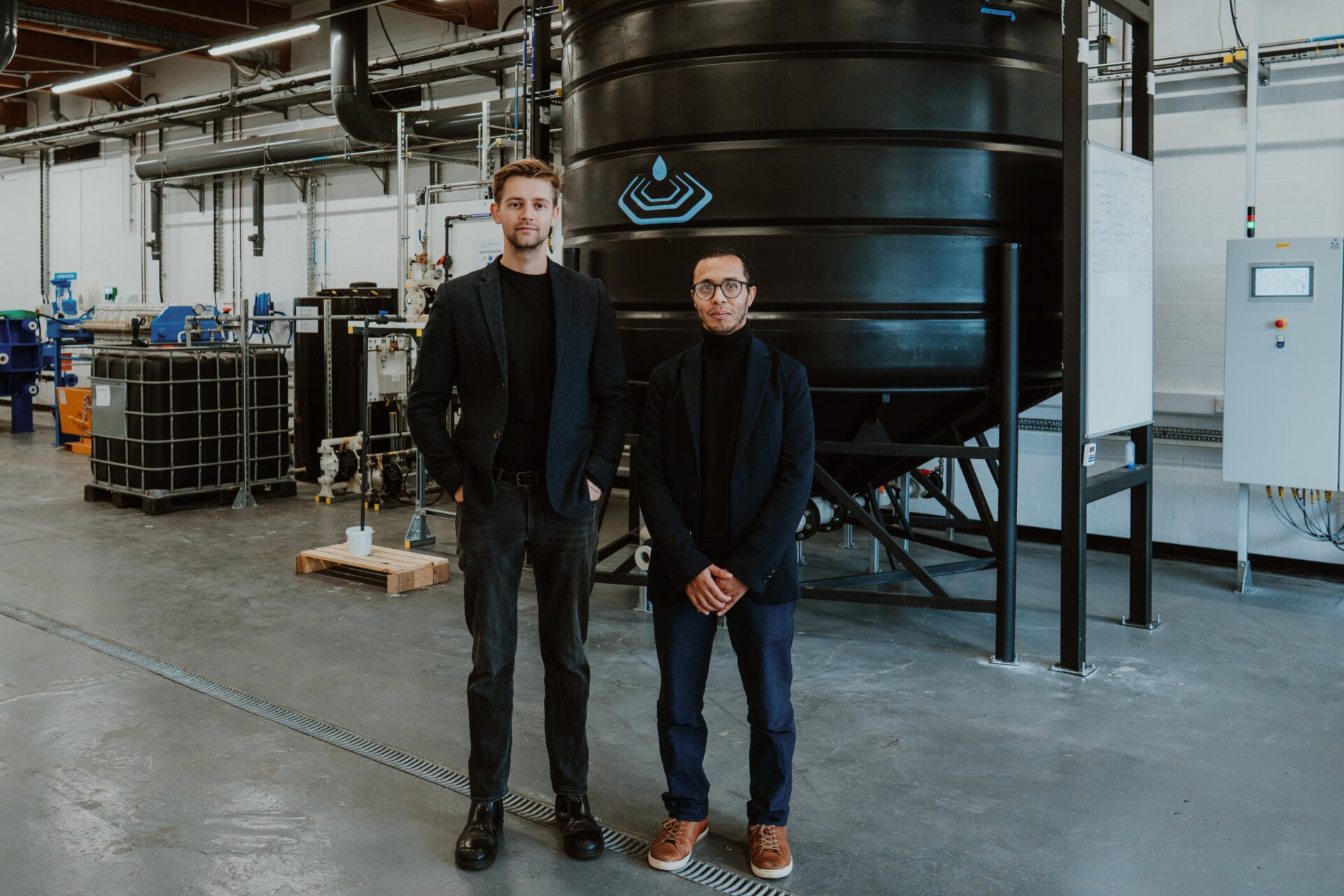
The University of Manchester Innovation Factory is proud to celebrate a landmark achievement by spinout company, Watercycle Technologies, which has commissioned Europe’s first commercially operating Direct Lithium Extraction (DLE) plant in Runcorn.
This breakthrough marks a global milestone in securing critical minerals for the energy transition and demonstrates the transformative impact of University research when successfully commercialised.
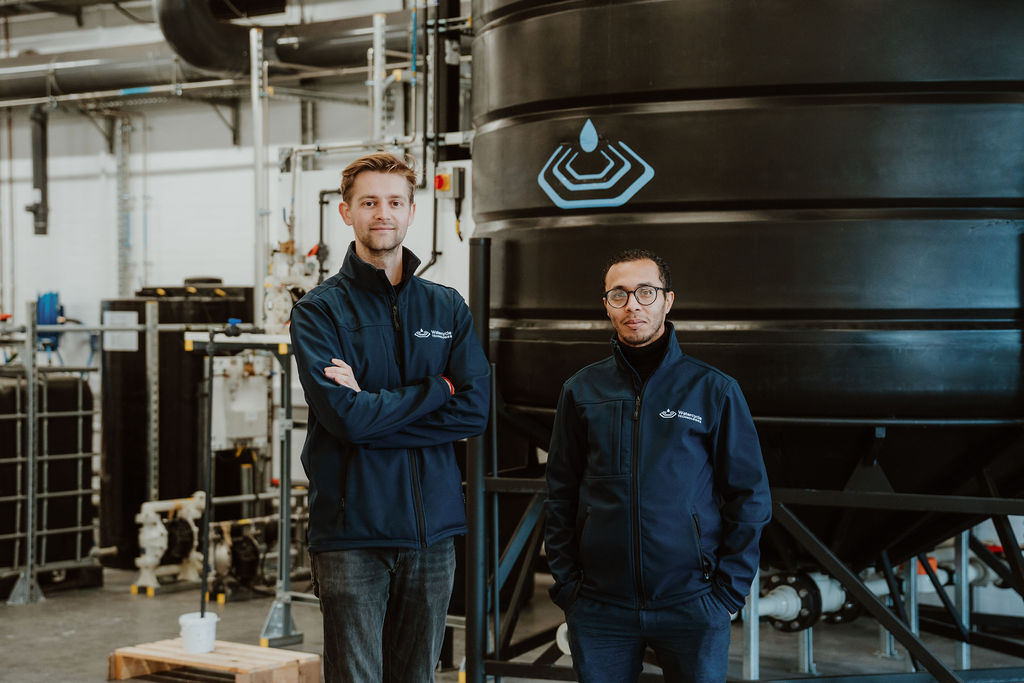
CEO, Dr Sebastian Leaper (L) and CTO, Dr Ahmed Abdelkarim (R)
Watercycle Technologies was founded from pioneering membrane science developed at the University of Manchester. Since its inception, the company has scaled its proprietary DLEC™ technology from bench experiments to containerised pilot systems, and now to full commercial deployment. The Runcorn plant is consistently producing hundreds of kilograms of lithium carbonate from UK sources, far exceeding the output of competing DLE technologies.
This achievement represents a major step towards the UK’s ambition to produce at least 50,000 tonnes of lithium carbonate equivalent domestically by 2035, and 150,000 tonnes per annum across Europe by the same date.
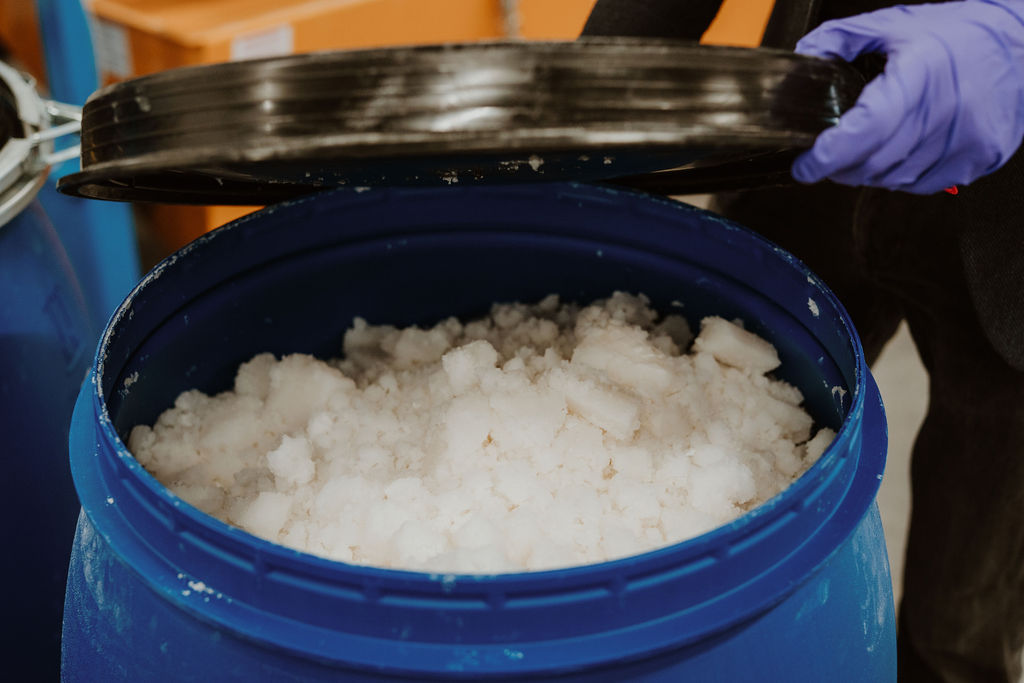
Watercycle Technologies Lithium Carbonate
Unlike conventional ion-exchange or adsorption processes, Watercycle’s technology operates across a wide range of brine types and industrial wastewater streams, including those from chemical processing and battery recycling. This innovation offers a circular, low-impact, and commercially viable pathway to securing one of the world’s most critical materials.
Dr Seb Leaper, CEO of Watercycle Technologies, commented:
“Direct lithium extraction has long been tipped as a breakthrough solution to the emerging lithium supply crisis, but no available technology has addressed the three key challenges of water consumption, energy consumption and cost – until now. We have spent the last three years perfecting a process that operates on every brine type we have tested, from low-lithium geothermal brines to saturated South American brines and organics-laden industrial wastewaters. This positions us to support both lithium resource owners and the emerging battery recycling industry with profitable, zero-waste solutions.”
The Runcorn facility is currently producing enough lithium carbonate equivalent to support the manufacture of 50 mid-sized electric cars per month, with output expected to grow substantially in 2026 as modular systems are deployed across the UK and internationally. This aligns directly with the UK Government’s Critical Minerals Strategy, which targets securing at least 10% of annual UK demand through domestic production and 20% through recycling by 2035.
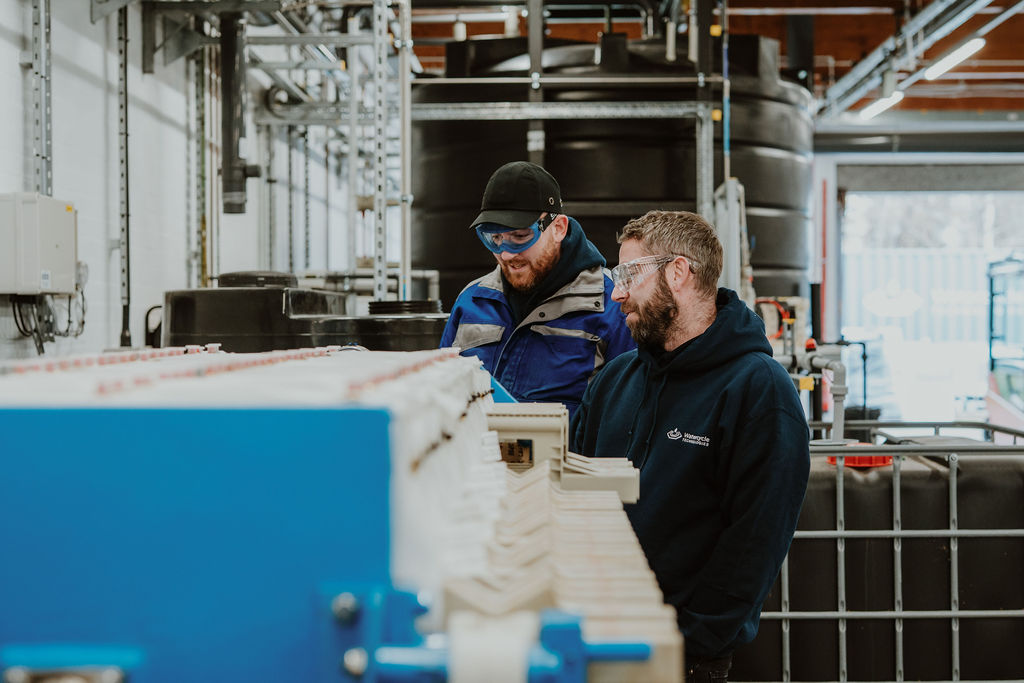
Watercycle Technologies Mike Walker Lead process engineer Shaun Yoxall Operations Technician
Dr Ahmed Abdelkarim, CTO of Watercycle Technologies, added:
“By opening the UK’s first commercial DLE plant, we are not only contributing to national lithium targets but also positioning Britain as one of Europe’s earliest leaders in this field. This is about more than lithium – it’s about building economic resilience, creating skilled jobs, and ensuring that the UK and Europe can meet the demands of the energy transition with confidence.”Dr Catherine Headley, CEO of University of Manchester Innovation Factory: “This marks a key achievement for Watercycle Technologies who have made phenomenal progress since their formation. This company exemplifies how a spinout can succeed in developing early discoveries made in a University, to make a positive impact both regionally and globally. Congratulations to Seb, Ahmed and the Watercycle team.”
The University of Manchester Innovation Factory’s Role
As the University’s Technology Transfer Office, the Innovation Factory exists to support researchers to transform world-class discoveries into real-world impact. Watercycle Technologies exemplifies this mission: a spinout that has taken breakthrough science from Manchester laboratories and scaled it into industrial production, delivering both economic and societal value.
This milestone demonstrates how University of Manchester spinouts are shaping the future of sustainable technologies and contributing directly to national and global priorities in critical minerals and clean energy.