


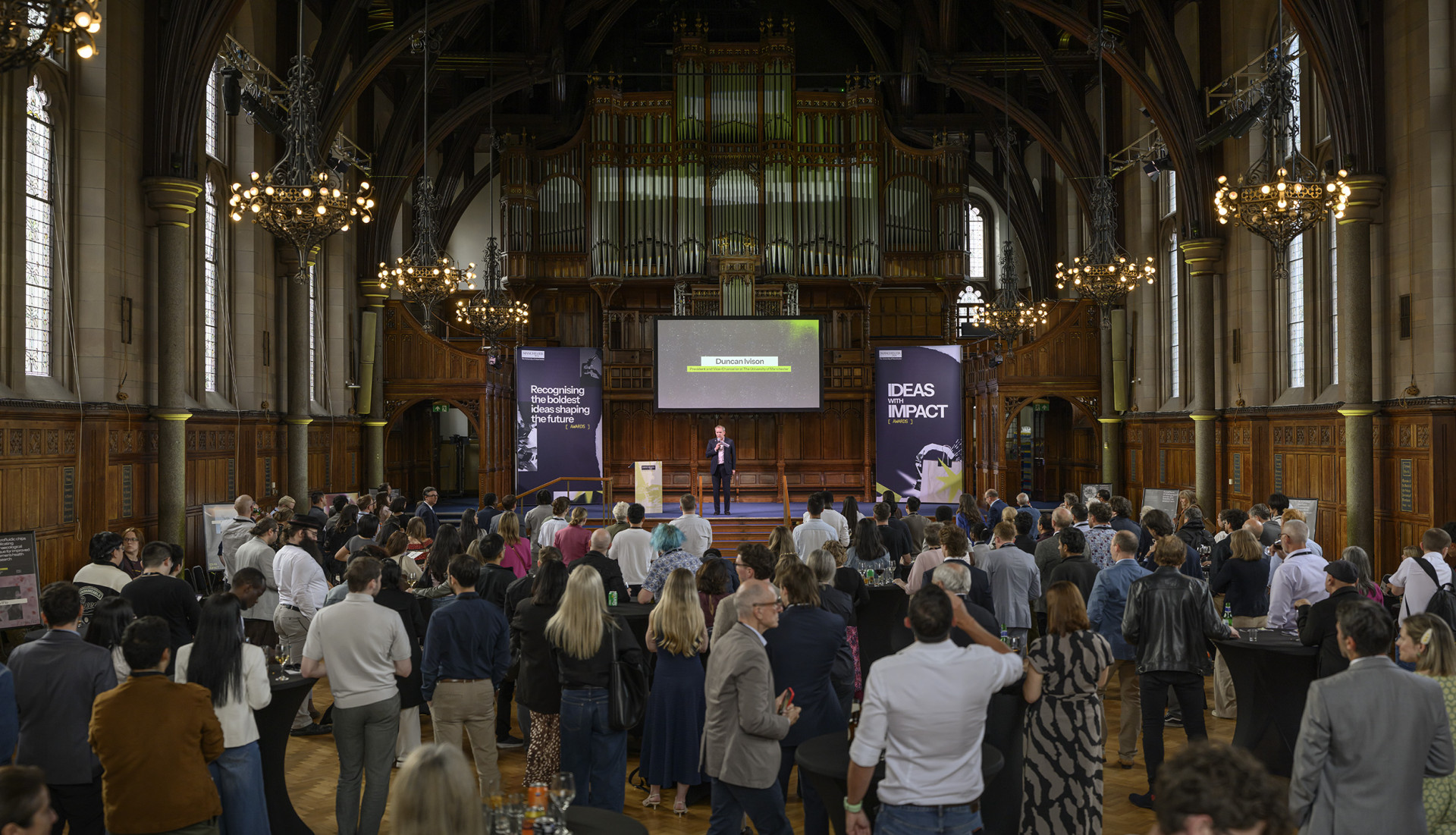
On Thursday 2nd July, the ten finalists of the 2026 Ideas with Impact Awards came together in Whitworth Hall at The University of Manchester to pitch their early-stage venture plans, for the chance to win a share of £350,000 in prize funding.
Open to innovators across all disciplines, the awards are made possible by our generous community of donors as part of our Challenge Accepted campaign. The final total raised for 2026 reached £350,000, including a new gift from CMSPI, to establish The CMSPI Future Technologies Prize.
Ideas with Impact provides winners with funding, expert mentoring and access to a network of founders and innovators, giving them the support and connections needed to turn promising ideas into impactful ventures. The awards are open to University staff, students and recent alumni, and aim to support entrepreneurs with innovative solutions to the world’s most pressing issues.
This year’s finalists, whittled down from over 170 applications, drew from a range of disciplines, from operating electrical power systems and zero-carbon fusion energy generation, to blood cancer treatment and countering antimicrobial resistance.
Alongside the award funding, all ten finalists have been getting support and will continue to work with the University of Manchester Innovation Factory as they develop their ventures and explore the most appropriate route to impact, whether through the creation of a spinout company, exploring licensing opportunities or securing further investment and support.
We are delighted to introduce this year’s winners and their ventures:
£100,000 – SwiftCas Diagnostics
We have developed simple, fast diagnostic tests that use CRISPR programmable nuclease technology to identify infections caused by a wide range of infectious agents, especially bacteria. Our approach can be easily adapted to detect different diseases, making it highly flexible. CRISPR diagnostic tests are accurate, affordable and rapid. These tests will help doctors diagnose infections and make informed treatment decisions within hours of assessing a patient, rather than after waiting several days for results. By speeding up diagnosis and improving precision, our technology has the potential to improve patient outcomes, reduce healthcare burden and limit the unnecessary use of antibiotics.
£75,000 – Monoblast Therapeutics
We are developing a first-in-class targeted therapy for Chronic Myelomonocytic Leukaemia (CMML), a rare blood cancer with no effective treatments and a median survival of 18–24 months. Our approach uses novel compounds conjugated to CCL2, a protein selectively taken up by disease-causing cells in CMML. Recent findings show that our third-generation CCL2-STING conjugates trigger rapid cell death in CMML monocytes, offering potential for superior efficacy and safety margin. Targeting a c.$1bn market with broader immuno-oncology potential, we aim to seek partnerships with pharmaceutical companies to advance these therapies with the aim of providing transformational therapy to CMML patients.
£75,000 – Fibrametric (The CMSPI Future Technologies Prize)
Every time we wash and wear our clothes, microscopic fibres are released into the environment carrying harmful chemicals including heavy metals and persistent pollutants, yet there is no standard way to monitor fibre release. We are developing an automated microfibre testing platform for textile laboratories that combines advanced imaging with repeatable analysis to accurately measure and understand fibre release. Designed to integrate directly into existing textile testing workflows, this system enables manufacturers, researchers and regulators to generate comparable evidence, support emerging standards and accelerate the development of lower-polluting textile products.
£50,000 – Grid Stability
Grid Stability Monitor (GSM) is an Artificial Intelligence (AI)-powered solution that supports stable and secure operation of electrical power systems. As renewable generation and low-carbon technologies continue to grow to achieve decarbonisation targets, existing assessment tools struggle to evaluate network stability risks quickly enough across the huge number of possible operating conditions and contingencies. GSM enables rapid stability assessment and better understanding of potential hidden underlying risks, supporting economical, on-demand procurement of stability services where and when needed. This unlocks effective use of low-carbon technologies, thereby overcoming a substantial barrier to decarbonising our energy use while keeping the lights on.
£50,000 – RadioVision
Commercial drones increasingly exploit 4G and 5G networks for long-range operations, exposing a critical security gap that traditional countermeasures miss. Our technology overcomes this challenge, leveraging advanced radio sensing with AI to passively analyse cellular network signalling without touching user data. This allows us to instantly identify and track network-connected drones disguised as regular mobile users for illegal activities. The system enables rapid global deployment to monitor any 4G or 5G network, delivering robust, proactive protection against next-generation aerial threats to secure critical infrastructure and airspace.
Attendee’s Choice – InViFlo
Microfluidic chips replicating gynaecological tissue for improved women’s health research. Women’s health has been chronically underfunded and underrepresented in medical research for decades, leaving millions without adequate diagnoses or treatments for conditions like endometriosis, vaginal infections and gynaecological cancers. InViFlo is working to address this global problem with their organ-on-a-chip technology.
These successful ventures will join a community of former winners who have used their funding to deliver real-world impact. Alexander Stokes was one of last year’s winners as part of the Imprinted Diagnostics team – a University of Manchester spinout working to improve the accuracy of diagnoses for heart attacks and cardiovascular disease. Imprinted Diagnostics is now raising seed funding to support its next stage of growth and impact.
“It was the starting fuel we needed to grow the company to what we are today, a core team of five and a wider network of more than 30 partners all working together to deliver one common goal of a portable blood test for heart attacks.” – Alexander Stokes, former winner, and founder of Imprinted Diagnostics
Another previous winner, Kay Marshall of MollaPharm, gave an update at this year’s awards. Working towards treating endometriosis through next-generation therapeutic conditions, Marshall praised the nature of the prize:
“The no strings approach adopted by Ideas with Impact has enabled our speedy progression, where red tape frequently slows things down. This has allowed us to push our invention forward faster so we can reach the women with endometriosis sooner rather than later.”
Our Vice-President for Civic Engagement and Innovation, Professor John Holden, said:
“Across our University community, talented people are developing bold ideas with the potential to improve lives, create opportunities and tackle some of society’s biggest challenges. Thanks to the generosity of our donors, we’re able to help turn that potential into reality through Ideas with Impact, supporting innovators at a crucial stage of their journey and helping ensure great ideas can deliver meaningful impact across Manchester and beyond.”
The judging panel said:
“The finalists this year exemplify the bold thinking, creativity and determination needed to tackle some of the most pressing challenges facing society today. As a judging panel, we were inspired not only by the calibre of ideas, but by the passion, commitment and entrepreneurial spirit of the people behind them. Ideas with Impact is about creating the conditions for innovators to transform promising ideas into ventures that deliver real-world change. We look forward to seeing how this year’s winners build on their success and create lasting impact in the years ahead.”
The judging panel included:
- Professor Aline Miller – Associate Vice-President (Enterprise), The University of Manchester
- Dr Ewelina Rozycka-Burn – Head of Commercial Development, The University of Manchester Innovation Factory
- Professor Lee Pugalis – Interim Director, the Masood Entrepreneurship Centre
- Professor Sarah Underwood – Head of the Strategy, Enterprise and Sustainability Department and University Academic Lead for Commercialisation at Manchester Metropolitan University
Innovation is at the heart of the University’s Challenge Accepted campaign, fuelling our ambition to become Europe’s most inclusive and impactful innovation network, and helping deliver progress that changes lives.